
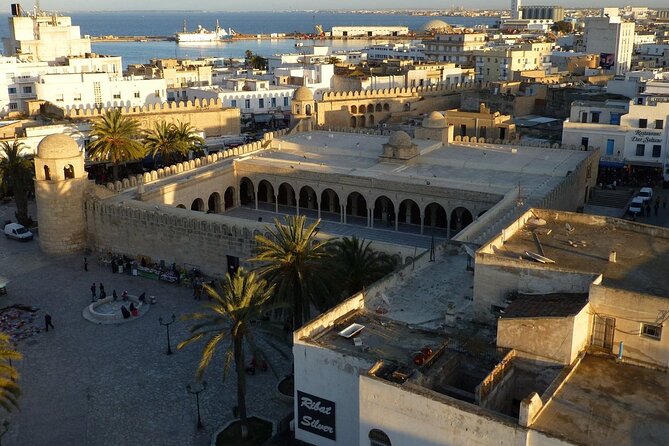
Reviewed · 3-DAY EXPERIENCES
The Best of Tunisia, 3 Days Guided Tour with Lunch
Tunisia rewards a packed plan. This three-day private tour links five UNESCO World Heritage sites with seaside towns, Roman ruins, Islamic monuments, and local medinas. I like the strong variety, and I like having a private guide and driver for long journeys between Tunis, Kairouan, El Jem, Sousse, and Monastir. The main drawback is simple: the schedule is full, so you will see many places without having much free time in any one of them.
The tour costs $494.77 per person and includes lunch, entrance tickets, pickup, and private transport. That is a serious price, but it can make sense if you want a short, organized introduction to Tunisia rather than arranging several day trips yourself. Guides and drivers praised by name include Fahmi with Said, Yousra with Saeed, and Chouaib with Ahmed, with punctual service, strong English, safe driving, and useful local advice repeatedly highlighted.
In This Review
- Key points to know before booking
- Day one: Tunis, La Goulette, Carthage, and Sidi Bou Said
- Walking the Medina of Tunis
- A pause by the sea in La Goulette
- Carthage, where ancient power meets modern streets
- Sidi Bou Said in blue and white
- Day two: Kairouan and the Roman arena at El Jem
- The Great Mosque of Kairouan
- The Aghlabid Basins
- The Medina of Kairouan
- Entering the El Jem amphitheater
- The Archaeological Museum of El Jem
- Day three: Hammamet, Sousse, and Monastir
- Hammamet’s old town and beaches
- Sousse’s UNESCO-listed medina
- Monastir’s Ribat
- A short finish at Monastir Marina
- What the $494.77 price really buys
- Guides, drivers, and the private format
- Who should book this three-day Tunisia tour?
- Should you book it?
- FAQ
- How long is the Best of Tunisia tour?
- Is this a private tour?
- Which UNESCO World Heritage sites are included?
- Are lunches included?
- Are admission tickets included?
- Is pickup available?
- What is the cancellation policy?
Key points to know before booking
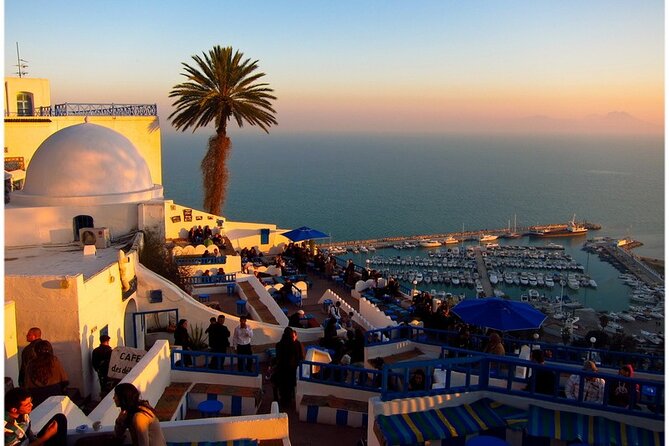
- Five UNESCO sites in three days: You visit the medinas of Tunis, Kairouan, and Sousse, plus Carthage and the amphitheater of El Jem.
- A private vehicle makes the route practical: Your own group travels with a guide and driver rather than joining a large coach.
- Day two is the longest historical stretch: Kairouan and El Jem bring major religious and Roman sites, but the day involves substantial road time.
- Lunch is part of the package: Meals are reported to showcase different Tunisian regions, adding food to the cultural experience.
- Sidi Bou Said brings a change of pace: Blue and white buildings, sea views, and cafe terraces offer a lighter stop after the ruins of Carthage.
- You need to enjoy a fast overview: The tour covers a lot of ground, but it is not designed for slow, unplanned exploration.
Day one: Tunis, La Goulette, Carthage, and Sidi Bou Said
The opening day gives you four very different views of the Tunis area. Pickup begins at 8:30 a.m., and the route moves from an old Islamic city to a seaside district, then to ancient Carthage and a hilltop village.
More trips with lunch included:
- Private tour: Medina,Carthage ,Sidi Bou Said, Bardo Museum+lunch
★ 5.0 · 230 reviews - Full Day Dougga & Bulla Regia Via Testour Private tour with Lunch
★ 5.0 · 29 reviews - Tour of Tunis Carthage and Sidi Boussaid with local lunch
★ 5.0 · 7 reviews
Walking the Medina of Tunis
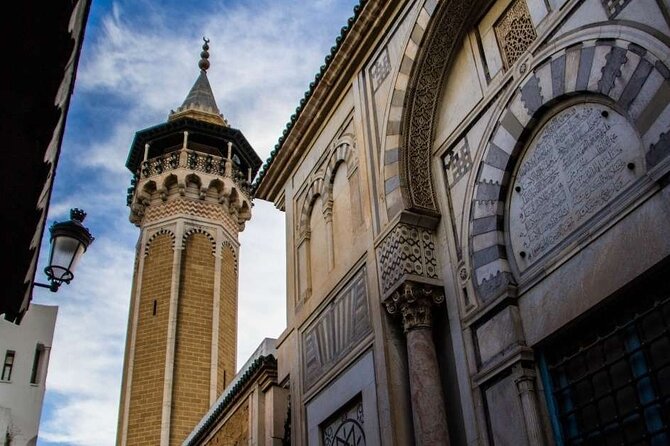
The Medina of Tunis is a strong first stop because it gives you the feel of a living city, not just a preserved monument. Its narrow streets form a large maze of souks, cafes, workshops, mosques, hammams, palaces, and religious schools.
You will have about 45 minutes here, with admission included. That is enough for an introduction, but not enough to inspect every lane or shop. Look closely at the painted doors, tiled walls, carved stucco, and marble columns. The medina is also a working neighborhood, so you may see residential doorways beside shops selling shoes, shisha items, and handmade goods.
A guide is especially useful here. Without one, the lanes can blur together, and you may miss the architectural details that explain why this medina matters. If shopping interests you, ask how much time is available before lingering over purchases. The schedule is tight.
A pause by the sea in La Goulette
La Goulette offers one hour and no admission fee. Its cafe and restaurant terraces line the waterfront, making this a more relaxed interlude between historic stops.
This is not presented as a major monument, so your expectations should be modest. I see it as a useful break from stone walls and narrow alleys. You can sit, take in the sea air, and watch local life unfold around the cafes. If lunch is served here, the stop may also help divide the day.
Carthage, where ancient power meets modern streets
The archaeological site of Carthage spreads across the present-day city of Carthage. You have about one hour and 20 minutes, with admission included.
That scattered layout is important. Carthage is not one single ruin with a neat entrance and a single grand view. Its remains are spread across several areas, so the guide’s explanations help you understand how the pieces fit together. The site’s UNESCO status dates to 1979, reflecting its importance as one of the Mediterranean’s major ancient centers.
This is one of the tour’s strongest stops, but it also shows the limits of a three-day plan. You will get an organized introduction to Carthage, not an exhaustive archaeological study. Wear comfortable shoes and pay attention to the guide’s timing, since the next stop is waiting.
More three-day trips:
- 3 Days South Tunisia Discovery Tour with luxury camp and Meals
★ 5.0 · 31 reviews - Private 3 Day Tour in Southern Tunisia or More
★ 5.0 · 17 reviews - The Tunisian South between Oasis and Mountain: 3 Days / 2 Nights Douz and Tozeur
★ 5.0 · 17 reviews - 3-Day South of Tunisia Guided Tour from Tunis
★ 4.0 · 3 reviews
Sidi Bou Said in blue and white
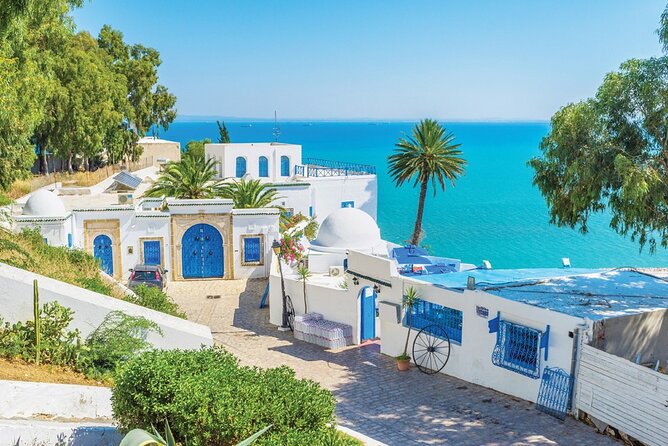
Sidi Bou Said is a welcome visual change. Its white buildings, blue details, cobbled streets, and views toward the sea make it one of Tunisia’s most photogenic places.
The village reflects Ottoman and Andalusian design, shaped in part by the arrival of Spanish Muslims in the 16th century. You have around 45 minutes and no admission fee. That allows time for a short walk, photographs, and perhaps a cafe stop if the schedule permits.
The village can feel more polished and leisure-focused than the Medina of Tunis or Carthage. That is not a flaw, but it gives the day a tourist-town finish. I like the contrast. After ancient ruins and dense city lanes, Sidi Bou Said gives you open views and a slower mood.
Day two: Kairouan and the Roman arena at El Jem
Day two is the tour’s historical heavyweight. You visit Kairouan’s major Islamic monuments, then continue to El Jem for one of the most impressive Roman buildings in North Africa.
Expect this to be a demanding day. The schedule includes five stops, and the road distances mean you should be ready for a full outing. The private car matters here. You can travel with your own group, keep your bags with you, and rely on a driver familiar with the route.
The Great Mosque of Kairouan
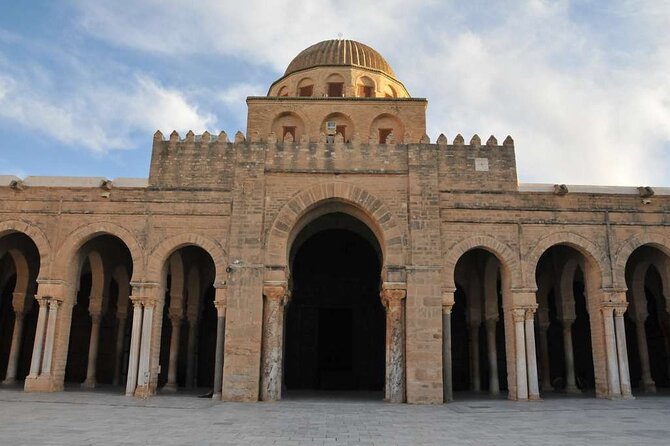
Kairouan is regarded as the fourth holiest city in Islam, and the Great Mosque is its defining monument. The structure was founded in 670 and has the appearance of a fortified adobe building.
Your 45-minute visit includes admission. The main features are the imposing minaret, the broad courtyard, arcades, carved cedar doors, and prayer rooms lined with marble columns. A sundial sits within the courtyard, adding a small practical detail to the monumental setting.
Even if you are not deeply interested in religious architecture, this stop is worth your attention. The mosque influenced later Maghreb mosque design, and its scale makes clear why Kairouan holds such an important place in Islamic history.
Dress and behavior should be respectful at religious sites. The tour description does not give specific clothing rules, so follow your guide’s instructions on where you may enter and what areas are open to visitors.
The Aghlabid Basins
The Aghlabid Basins sit outside Kairouan’s medina and date from the second half of the 9th century. You spend about 30 minutes here, with admission included.
These water reservoirs are less visually ornate than the Great Mosque, yet they explain how a major city managed its water supply. They are considered among the most important hydraulic works in the history of the Muslim world.
I would not rush this stop simply because it lacks the decorative details of a mosque or palace. Ask your guide how the basins worked and why their placement mattered. That context turns what could seem like a pair of large tanks into an essential part of Kairouan’s development.
The Medina of Kairouan
The Kairouan medina receives about an hour. It is known for its preserved character, souks, carpets, and traditional pastries called makroudh, also spelled mekroudhs.
This is one of the better places to leave room for your senses. Look for carpet making, browse the lanes, and ask about the pastry rather than treating the medina as a quick photo stop. The tour includes admission, and a local guide can help you understand the difference between a genuine craft item and a purchase made only for tourists.
An hour passes quickly. If you want time for shopping, say so early. The tour continues to El Jem, so you may need to choose between a relaxed browse and a more focused visit.
Entering the El Jem amphitheater
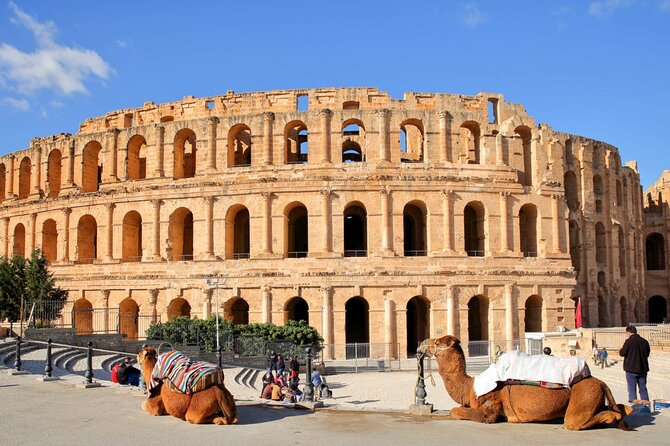
The amphitheater of El Jem is the visual high point of day two. Built in the 3rd century AD, it could hold about 30,000 spectators and is described as the third-largest amphitheater in the Roman world, after Rome and Capua.
You have one hour and 20 minutes, with admission included. That is enough time to walk through the arena, inspect the seating levels, and see the underground passages. The structure remains remarkably imposing, especially when you consider its size within the surrounding town.
The site was declared a UNESCO World Heritage site in 1979. The tour description also gives 1972 for the museum’s heritage designation, so the amphitheater and museum should be treated as separate stops with different dates in the supplied information.
This is a place where the guide’s commentary adds real value. Stone alone cannot explain how the arena functioned, who used it, or how it fitted into the ancient city of Thysdrus. Take time to look upward and outward. The scale is easier to grasp from the upper seating areas.
The Archaeological Museum of El Jem
The nearby museum gets 40 minutes. It was founded in 1970 and renovated in 2002, on the site of a Roman villa.
The building follows the villa’s original layout, with rooms arranged around a central courtyard and peristyle. Inside, you can see sculptures, mosaics, ceramics, and other objects found at Thysdrus and nearby sites.
The museum is a smart companion to the amphitheater. The arena shows the city’s public face, while the villa and household objects offer a closer look at daily life. If you are tired by this point, focus on the mosaics and the restored villa layout. They provide a quieter counterpoint to the enormous arena.
Day three: Hammamet, Sousse, and Monastir
The last day moves through Tunisia’s coastal Sahel. It begins in Hammamet, continues to the medina of Sousse, and ends with Monastir’s Ribat and marina.
After the long historical route on day two, this day feels more varied. You get a resort town, a UNESCO-listed coastal medina, a fortress-like religious building, and a port.
Hammamet’s old town and beaches
Hammamet is known for beaches, nightlife, white houses, jasmine, and its medina beside the sea. You spend about an hour here without an admission charge.
The town has two sides. The summer resort area is more contemporary, while the old medina retains a smaller-scale character with ramparts and sandy lanes. Nearby Yasmine Hammamet offers a newer resort setting, and the surrounding countryside includes lemon groves and wooded areas.
This stop is best for atmosphere rather than a long list of monuments. If you have already visited several medinas, Hammamet’s appeal is its coastal setting and lighter pace. If beaches are a priority, note that this is a sightseeing stop, not a beach day.
Sousse’s UNESCO-listed medina
The Medina of Sousse receives one hour and includes admission. Its layout reflects Arab-Muslim urban planning in a coastal city exposed to seaborne attacks and piracy.
That setting helps explain the medina’s defensive character. You will see how the city’s religious, commercial, and protective functions fit together within a compact area.
Sousse is a useful comparison with Tunis and Kairouan. Tunis feels larger and more maze-like. Kairouan feels more closely tied to religious tradition and craft. Sousse brings the sea and defense into the picture. The short visit gives you the outline, though not much time for independent wandering.
Monastir’s Ribat
The Ribat of Monastir is the final major monument and one of the tour’s most memorable. Founded in 796, it is described as the oldest and most important defensive work built along the Maghreb coast by early Arab conquerors.
You have 45 minutes and admission is included. The building began as a quadrilateral complex around two courtyards, with small cells for warrior monks, prayer rooms, and defensive spaces. One prayer room now holds objects linked to worship and medieval crafts.
A hundred spiral steps lead to the watchtower. If you are comfortable with the climb, go up for the view and a better sense of the Ribat’s defensive purpose. The stairs may not suit everyone, and the schedule does not promise extra time, so ask your guide before starting the ascent.
A short finish at Monastir Marina
The marina receives 30 minutes and includes admission. It functions as a port of call, passage, wintering, and regatta harbor.
This is a gentle ending after the Ribat. You can walk near the boats and take in the seafront before the tour finishes. It is not as historically significant as the fortress, but it gives the final afternoon a change of rhythm.
What the $494.77 price really buys
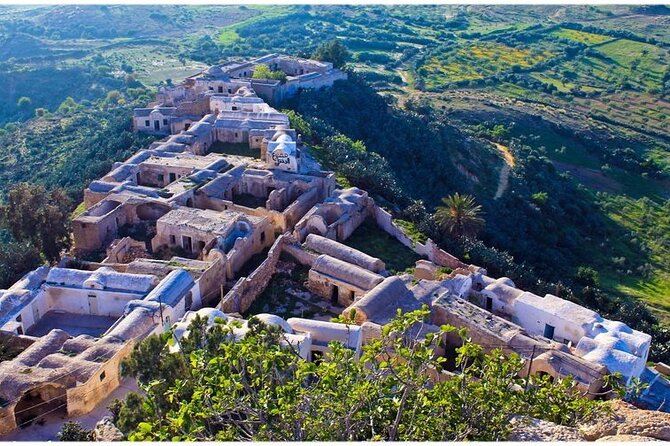
The cost is $494.77 per person. The value depends on how much you would otherwise spend arranging transport, guides, entrance fees, lunches, and intercity travel.
This is a private activity, so only your group participates. Pickup is offered, mobile tickets are available, and group discounts may apply. Entrance tickets are included at the named archaeological and religious sites, and lunch is included as well.
The strongest value comes from the route. Tunis, Kairouan, El Jem, Sousse, and Monastir are spread across the country, and fitting them into three days requires efficient driving. You also avoid the uncertainty of finding separate transport between each city.
The price is harder to justify if you prefer long meals, slow museum visits, or free afternoons. This is a sightseeing circuit, not a leisurely coastal holiday. I would book it when your time in Tunisia is short and your priority is seeing major landmarks with local guidance.
Guides, drivers, and the private format
The human side of this tour matters as much as the monuments. Fahmi was praised for clear English and broad language skills, while Said was praised for reliable driving. Yousra and Saeed were described as attentive and careful, and Chouaib and Ahmed were valued for local knowledge, safe driving, punctuality, and knowing how to avoid crowded spots.
Assignments can vary, so you should not assume you will receive one particular pair. Still, the repeated praise points to the service qualities that matter most here: arriving on time, explaining sites clearly, driving safely, and adjusting small details for your group.
Private travel also lets you ask questions without holding up a busload of people. Use that advantage. Tell the guide if you want more architecture, more food, more shopping, or more time for photographs. The official schedule is fixed, but a private format may allow small adjustments when timing permits.
Who should book this three-day Tunisia tour?
I would recommend it to a first-time visitor who wants a serious overview in limited time. It suits people who value history, architecture, organized transport, and local explanations more than beach time or nightlife.
Families and small groups may also appreciate the private setup, since most people can participate and service animals are allowed. The tour is near public transportation, though pickup is offered, making the start easier.
I would hesitate if you dislike early starts, long drives, or tightly timed sightseeing. Three days cannot give every site the attention it deserves. Day two, in particular, asks you to stay alert through several major stops.
Should you book it?
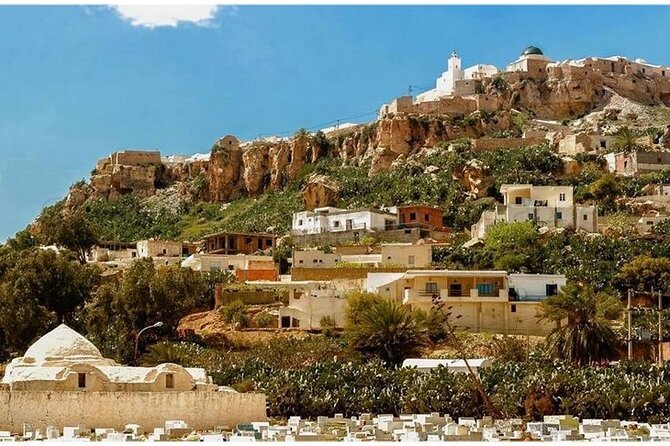
Book this tour if you want Tunisia’s major sights linked into one efficient route. The strongest reasons are the five UNESCO sites, the private vehicle, included lunches and admissions, and the mix of ancient, Islamic, and coastal settings.
Skip it if your ideal trip means staying in one town and exploring at your own pace. For everyone else, $494.77 can be fair value, especially when your time is limited and you want a guide to make sense of places such as Carthage, Kairouan, and El Jem.
Free cancellation is available up to 24 hours before the 8:30 a.m. start time. The experience requires good weather, and a weather cancellation offers either a different date or a full refund.
FAQ
How long is the Best of Tunisia tour?
The tour lasts approximately three days, with a scheduled start time of 8:30 a.m.
Is this a private tour?
Yes. Only your group participates in the activity.
Which UNESCO World Heritage sites are included?
You visit the Medina of Tunis, the archaeological site of Carthage, Kairouan, the amphitheater of El Jem, and the Medina of Sousse.
Are lunches included?
Yes. Lunch is included in the tour price.
Are admission tickets included?
Admission is included for the Medina of Tunis, Carthage, the Great Mosque of Kairouan, the Aghlabid Basins, the Medina of Kairouan, the El Jem amphitheater, the El Jem Archaeological Museum, the Medina of Sousse, the Ribat of Monastir, and Monastir Marina.
Is pickup available?
Yes. Pickup is offered, and the meeting time is 8:30 a.m.
What is the cancellation policy?
You can cancel at least 24 hours before the experience begins for a full refund. Cancellations or changes made less than 24 hours before the start time are not accepted for a refund.
Just added around Tunis
- Explore Tunisia in Depth:The Private Grand Tour in 8 Days★ 5.0 · 3 reviews
- 3-Day South of Tunisia Guided Tour from Tunis★ 4.0 · 3 reviews
- Private Tour Bardo Museum, Carthage, Sidi Bou Said and Medina★ 4.5 · 3 reviews
- Private Group Day Tour Tunis Medina Carthage Sidi Bou Said★ 4.5 · 3 reviews
- Bardo Museum- The ruins of Carthage- Village of Sidi Bou Said★ 5.0 · 4 reviews
- 5 Days Tunisia Discovery Private Tour★ 5.0 · 4 reviews
- Tunis Carthage Private Arrival Airport Transfer to Tunis★ 5.0 · 4 reviews
- 4-Day Private Tour: Sahara and Djerba Island from Tunis and Hammamet★ 5.0 · 4 reviews
3-Day Experiences, compared.
3 Days South Tunisia Discovery Tour with luxury camp and Meals
Read our review →
The Tunisian South between Oasis and Mountain: 3 Days / 2 Nights Douz and Tozeur
Read our review →
3-Day Private Excursion to the Sahara departing from Hammamet
Read our review →
3-Day Tunisia Sahara Desert Camel Trek from Douz
Read our review →
3DAYS 4×4 safari from Sousse/Hammamet/Tunis 100km deep in desert camp
Read our review →
Browse the lists this tour appears in