
Reviewed · KAIROUAN TOURS
Kairouan, El Djem and Monastir Guided Excursion from Hammamet
Three eras fit into one long day. This private excursion links Kairouan’s Islamic landmarks with El Djem’s enormous Roman amphitheater and Monastir’s modern Tunisian story. I like the strong variety, and I like having private transport, bottled water, and a guide included rather than piecing together three distant stops yourself.
The main drawback is the pace. Ten hours is a full day, and the listed visits leave little spare time. You also pay separately for several entrance tickets and lunch, so the advertised group price is not the final cost for two people.
In This Review
- Key points at a glance
- Why this Hammamet day trip works
- Starting with Kairouan’s Aghlabid Basins
- Sidi Sahbi Mosque and a quieter side of Kairouan
- Kairouan’s medina, markets, and three-gated mosque
- Entering El Djem’s 30,000-seat amphitheater
- Roman mosaics inside the El Djem museum
- Monastir, Bourguiba, and the marina
- What the private vehicle adds
- The guides and the quality of explanation
- Timing, tickets, and practical planning
- Who should book this excursion?
- Should you book Kairouan, El Djem, and Monastir?
- FAQ
- How long is the excursion?
- Where does the tour start?
- Is this a private tour?
- What is the price?
- Is transportation included?
- Is a guide included?
- Are entrance tickets included?
- Is lunch included?
- What does the Kairouan portion include?
- Can I cancel for a full refund?
Key points at a glance
- Kairouan in three contrasting stops: See the Aghlabid Basins, Sidi Sahbi Mosque, and the old medina in one concentrated visit.
- El Djem’s giant Roman amphitheater: Spend two hours at the best-known monument of the day, with room to explore its seating, passages, and scale.
- A reconstructed Roman villa: The El Djem Archaeological Museum adds mosaics, statues, glassware, and smaller objects to the amphitheater visit.
- Private transport for up to two people: The $292.47 price covers the group, not each passenger, which can be reasonable for a couple or close friends.
- Guiding in several languages: Feedback highlights excellent French from guide Mtir and an experienced Spanish-speaking guide on another departure.
- A firm but useful cancellation rule: You receive a full refund if you cancel at least 24 hours before the start time.
Why this Hammamet day trip works
Kairouan, El Djem, and Monastir give you three very different views of Tunisia. Kairouan focuses on Arab-Muslim Tunisia and religious tradition. El Djem carries you back to Roman Africa. Monastir brings the story forward to the country’s modern republic, while still keeping one foot in the Punic and Roman past.
That range is the best reason to choose this outing. You are not spending ten hours looking at similar ruins. One stop brings water engineering, another brings religious architecture, another puts you inside a Roman entertainment arena, and the final stop connects the coastal city to Habib Bourguiba, Tunisia’s first president.
I also like the private format. Only your group participates, and pickup is offered from Hammamet. That matters on a demanding day because you do not need to wait for a large coach group at every stop. The driver and guide can also respond to your pace within the limits of the schedule.
Still, this is not a slow village outing. The day is built around six planned stops and roughly ten hours on the road and at sites. If you prefer long café breaks, extended shopping, or unhurried photography, you may find the program tight. If your time in Tunisia is limited, though, the packed schedule gives you a strong historical overview.
More Kairouan visits:
- Private and Guided Tour to Kairouan and El Jem and Monastir
★ 4.5 · 22 reviews - Kairouan & El Djem Guided Day Trip with Lunch from Hammamet
★ 4.0 · 18 reviews - Kairouan, El Djem, Monastir Self-Guided Excursion from Hammamet
★ 4.5 · 5 reviews
Starting with Kairouan’s Aghlabid Basins
The first stop is the Bassins Aghlabites, outside Kairouan’s medina walls. These ninth-century basins were built during the second half of the ninth century and are regarded as major hydraulic works in the history of the Muslim world.
Allow about 30 minutes here. That is enough for an introduction and a close look, but not for a long stop. The value is not decoration. The basins show how a major city managed water in an arid setting, giving you a practical foundation for understanding Kairouan before you enter its religious quarter.
The admission is listed as free. That keeps the opening stop simple. You can focus on the explanation from your guide and on the shape and scale of the water system rather than dealing with a ticket line.
Sidi Sahbi Mosque and a quieter side of Kairouan
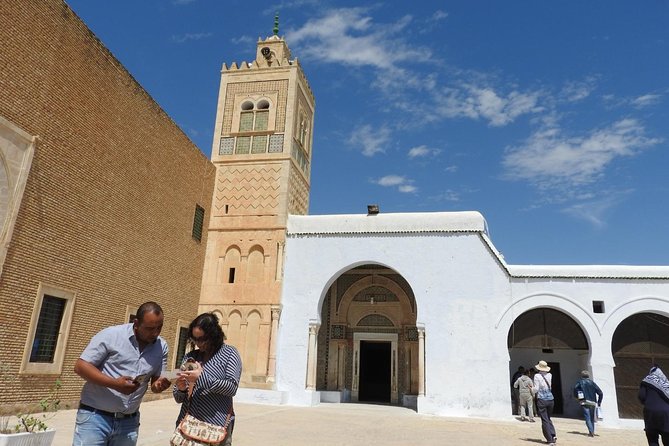
Next comes the Mosque of the Barber, also called the mausoleum of Sidi Sahbi. It sits outside the medina walls and is tied to Sidi Sahbi, a companion of the Prophet Muhammad according to the site’s religious tradition.
The planned visit lasts one hour. This gives the guide time to explain the mausoleum and its role in Kairouan’s spiritual life. It also gives you more than a quick photo stop, which is important at a place where the meaning is as important as the building itself.
The stop is listed without an admission charge. You should still listen carefully to your guide about the visit’s local customs, since religious sites call for respectful clothing and behavior. The supplied information does not set out a dress code, so it is best to arrive prepared with conservative options.
Kairouan’s medina, markets, and three-gated mosque
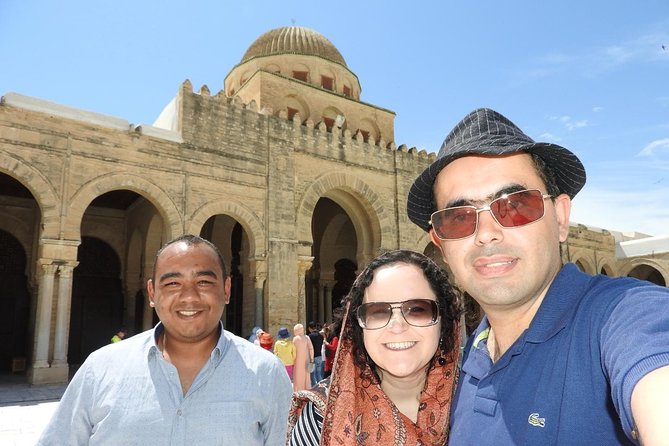
The Kairouan medina receives another hour. Its narrow lanes and markets offer a change from the open space of the basins and the formal setting of the mausoleum.
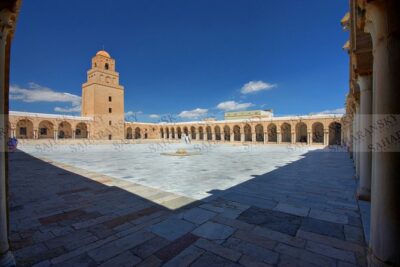
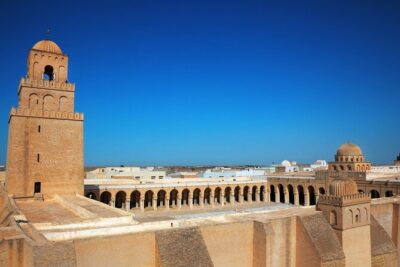
The old city has been on the UNESCO World Heritage List since December 9, 1988. The visit also includes the Mosque of Three Gates, one of the named sights in the program. Together, the lanes, markets, and mosque give you a sense of Kairouan as a living city, not just a set of monuments.
I would use this hour for orientation rather than serious shopping. One hour passes quickly in a medina, especially if you stop to examine details or listen to a long explanation. If buying something matters to you, ask your guide how much time is realistic before you commit to a shop or market stall.
The first three Kairouan visits are listed with free admission. That does not mean the whole day is ticket-free. The larger paid costs come later at El Djem and Monastir.
A few more excursions of this kind worth a look:
- Private tour: Medina,Carthage ,Sidi Bou Said, Bardo Museum+lunch
★ 5.0 · 194 reviews - Quad ride on the hills of Hammamet
★ 4.0 · 104 reviews - 2-Day Tunisian Sahara Tour with Food & Stay from Hammamet
★ 4.5 · 80 reviews - Tour to the Medina of Hammamet and the Spice Market of Nabeul
★ 4.0 · 45 reviews
Entering El Djem’s 30,000-seat amphitheater
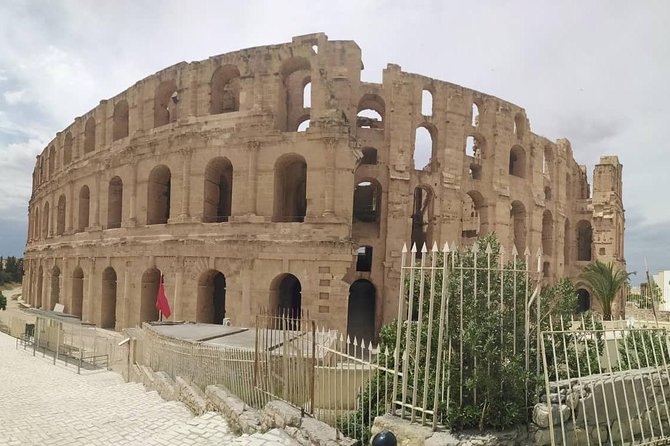
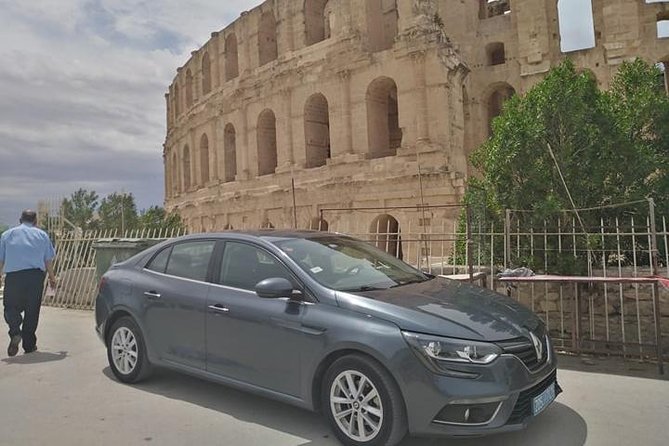
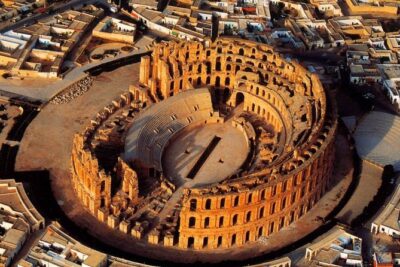
El Djem is the day’s visual heavyweight. The Roman city was known as Thysdrus and was one of the most prosperous cities of Roman Africa. Its amphitheater dates from the third century AD and could hold about 30,000 spectators.
You have two hours here, which is a sensible allocation. A quick walk around the outside would miss the main point. The size becomes clearer when you move through the interior, look across the seating areas, and follow the lower passages. Even without an elaborate explanation, the building makes Roman public entertainment feel large, organized, and costly.
The amphitheater was classified as a World Heritage site in 1972. It is described as the third largest in the Roman world after those at Rome and Capua, and as the most impressive Roman monument in Africa. Those comparisons help, but the physical experience matters more. You can see how an arena of this scale dominated the town and imagine the movement of tens of thousands of people through one structure.
The entrance fee is not included. That is an important budget note because the amphitheater is one of the core reasons to book the day. Keep some money available for site admission and personal expenses.
Two hours can feel generous if you only want the headline view, but it is useful if your guide gives a proper explanation. One review praised the guide for providing a great deal of information, and that is particularly valuable here. The amphitheater is easy to photograph but easier to understand with context about Roman Africa and the city of Thysdrus.
Roman mosaics inside the El Djem museum
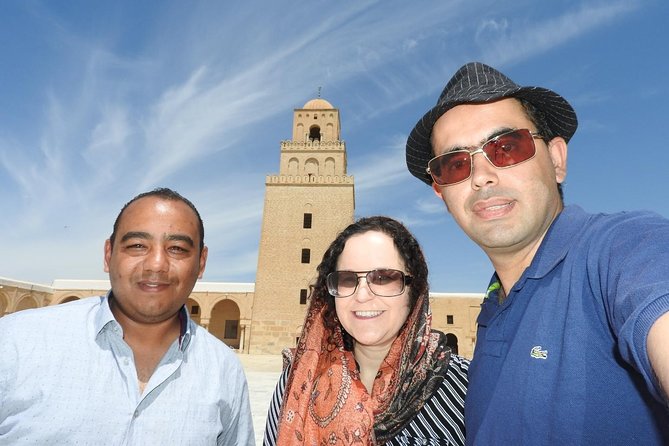
The Archaeological Museum of El Djem follows the amphitheater and lasts about one hour. It is housed in a reconstructed Roman villa and holds mosaics, statues, terracotta statuettes, perfume vials, and other glass objects.
This is a good companion to the arena. The amphitheater shows public life and engineering. The museum gives you a closer look at domestic decoration, art, and small objects. Roman mosaics are often best appreciated indoors, where you can study patterns and figures without the distraction of a huge monument.
The date range in the supplied description is given as the 11th century to the 5th century, which is unusual wording for a Roman collection. I would rely on the guide’s explanation at the museum rather than trying to draw firm conclusions from that range alone.
Admission is not included. You should also remember that the museum adds an hour to the El Djem section, so the stop is not simply an exterior photo opportunity. If you enjoy archaeology, this extra time improves the value of the day. If you only want the amphitheater, you may find the museum less essential, but it gives the Roman visit more substance.
Monastir, Bourguiba, and the marina
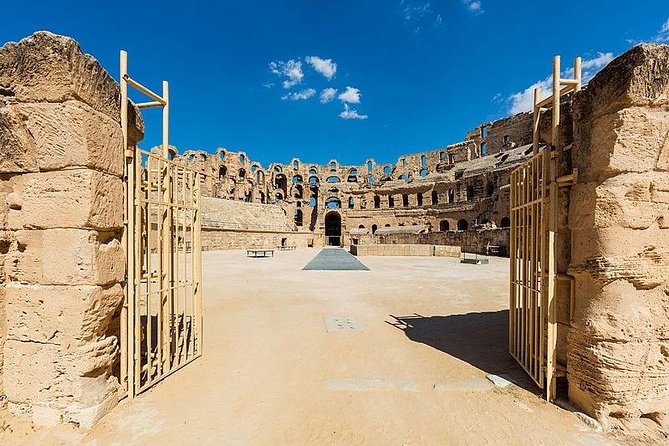
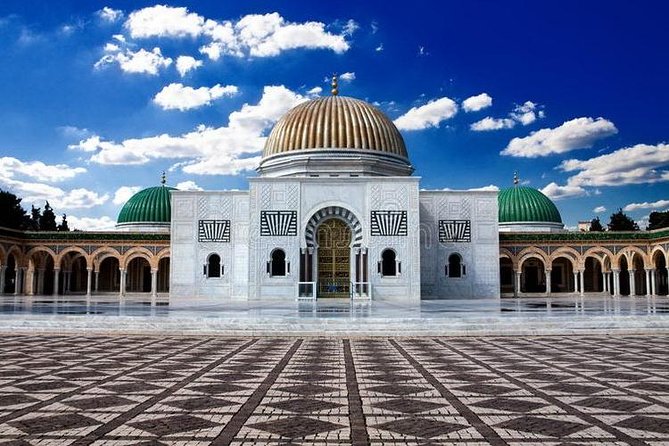
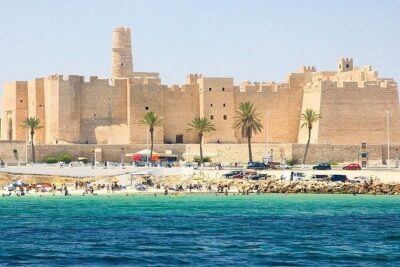
The final major stop is Monastir, a coastal city with Punic and Roman roots and a strong modern political connection. The itinerary includes a passage in front of the birthplace of Habib Bourguiba, Tunisia’s first president, followed by a visit to his mausoleum.
This shift to modern Tunisia is useful. After Kairouan and El Djem, you are no longer looking only at distant centuries. Bourguiba’s place in the country’s republican story gives the day a more recent human focus.
You also receive free time to visit the ribat and the marina. The schedule assigns one hour to Monastir, so you will need to choose how to use it. If the ribat matters most, head there first. If you want a short waterfront pause, the marina provides a different setting from the inland monuments.
The admission fee for this portion is not included. The details do not specify separate ticket prices, so you should treat the listed tour price as covering transportation and guiding rather than every entrance. That is the clearest way to avoid a surprise at the end of the day.
The one-hour limit is the main constraint. Monastir could easily fill a longer visit, but on this excursion it serves as a final sample rather than a full city tour.
What the private vehicle adds
The tour includes an air-conditioned vehicle, private transportation, bottled water, all listed taxes and fees, and a professional guide. Pickup is offered, and the activity is private for your group.
For a ten-hour route with three destinations, air conditioning is more than a luxury. It gives you a dependable place to reset between sites, especially after walking through the medina or exploring the amphitheater. Bottled water is another small but useful inclusion on a long sightseeing day.
The private setup is most valuable for two people. At $292.47 per group of up to two, the price works out to about $146.24 per person if two people book together. That is not a low-cost day trip, but it includes a dedicated vehicle and guide rather than a seat on a large shared tour.
I would judge the value by your alternative. If arranging transport between Hammamet, Kairouan, El Djem, and Monastir would be difficult, the cost buys simplicity and a structured day. If you already have a car and prefer to pay only for individual entrances, the price may feel high.
Lunch is not included. Since the program is long and the schedule is full, plan for that expense and ask about the practical meal timing at the start of the day. Personal purchases are also your responsibility.
The guides and the quality of explanation
The strongest praise is directed at the service, punctuality, and guiding. The feedback includes specific appreciation for Mtir, described as cultured, open to discussion, and fluent in French. Another departure included an experienced Spanish-speaking guide, and the overall service was praised for keeping to the agreed times.
That detail matters because this tour is information-heavy. Kairouan, Roman Africa, and modern Monastir each require different background. A good guide helps connect them rather than presenting six unrelated stops.
The information provided does not promise one named guide for every departure or guarantee a particular language. You should confirm your preferred language when booking. French and Spanish guiding are both reflected in the experience details, but availability may depend on the assigned guide.
The private format also gives you a better chance to ask questions. One review specifically praised the guide’s precision and openness to discussion. That is useful if you want more than a standard speech at each monument.
Timing, tickets, and practical planning
The full duration is about ten hours. The listed stop times add up to six and a half hours, leaving the rest for pickup, driving, and transitions between the three destinations.
That makes an early start and steady pace important, although the exact pickup time is not provided. Your confirmation should give the start details. Pickup is offered from Hammamet, but the supplied information does not specify the exact hotel coverage or pickup window.
The first three Kairouan stops list free admission. Entrance fees are not included for the El Djem amphitheater, the Archaeological Museum, and the Monastir portion. All fees and taxes are included as a tour feature, but that should not be confused with admission to museums or exhibitions.
The experience can accommodate most people, and service animals are allowed. It is still a walking-heavy cultural day, with narrow medina streets and a large archaeological site. The information does not provide details about step-free access or vehicle modifications, so ask the provider if you have mobility needs.
Free cancellation is available up to 24 hours before the start time for a full refund. Changes or cancellations inside that 24-hour window are not accepted for a refund.
Who should book this excursion?
I would choose this tour if you are staying in Hammamet and want to see major inland and coastal landmarks without arranging several separate journeys. It suits couples, families, and friends who value a private vehicle, a guide, and a day built around history.
It is especially good for first-time visitors to Tunisia who want a broad introduction. You get religious Kairouan, Roman El Djem, and modern Monastir in one sweep.
I would hesitate if you want a relaxed holiday rhythm. The schedule is full, lunch costs extra, and the paid admissions add to the headline price. You may also prefer a shorter excursion if your children do not enjoy long museum and ruin visits.
Should you book Kairouan, El Djem, and Monastir?
Book it if your priority is range and convenience. The day connects three important chapters of Tunisia, and the private format gives you comfort and a guide’s explanation without a large group.
Before paying, confirm the pickup details, guiding language, and expected entrance costs. Also budget for lunch. With those points clear, the $292.47 group price can be fair for two people who want a well-supported full-day outing from Hammamet.
FAQ
How long is the excursion?
The excursion lasts approximately 10 hours.
Where does the tour start?
The experience is based in Hammamet, Tunisia, and pickup is offered.
Is this a private tour?
Yes. Only your group participates, with a maximum of two people for the listed group price.
What is the price?
The listed price is $292.47 per group of up to two people.
Is transportation included?
Yes. Private transportation in an air-conditioned vehicle is included.
Is a guide included?
Yes. A professional guide is included.
Are entrance tickets included?
No. Entrance fees to museums or exhibitions are not included. The El Djem amphitheater, the El Djem Archaeological Museum, and the Monastir portion list admission as not included.
Is lunch included?
No. Lunch is not included.
What does the Kairouan portion include?
It includes the Aghlabid Basins, the Mosque of the Barber, and the Kairouan medina, including the Mosque of Three Gates.
Can I cancel for a full refund?
Yes. You can cancel at least 24 hours before the experience start time for a full refund. Cancellations within 24 hours are not refundable.
Just added around Hammamet
- Cap-Bon Self-Guided Excursion from Hammamet★ 4.5 · 3 reviews
- Airport Tunis Carthage Private Transfer to/from Hammamet★ 4.0 · 4 reviews
- Private Excursion of Friguia Park and Medina of Hammamet★ 4.5 · 4 reviews
- Executive: Transfer Tunis Airport to Hammamet by Mercedes E Class★ 5.0 · 4 reviews
- Tunis, Carthage and Sidi Bou Said Self-Guided Excursion from Hammamet★ 4.5 · 4 reviews
- Kairouan, El Djem, Monastir Self-Guided Excursion from Hammamet★ 4.5 · 5 reviews
- DayTrip to KORBOUS Thalasso-Thermal Bath & Spectacular SEA Cliffs★ 4.5 · 5 reviews
- Day trip to Cape Bon★ 4.0 · 5 reviews
Kairouan Tours, compared.
Fun VIP Tour: El Jem, Kairouan, Monastir/Sousse (PICKUP ALL City)
Read our review →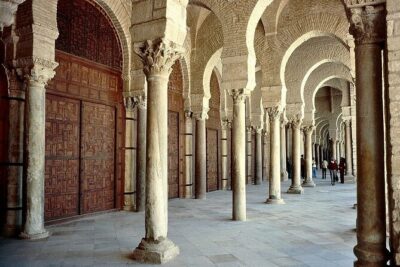
Private Tour to Kairouan, El Jem & Monastir from Tunis_hammamet
Read our review →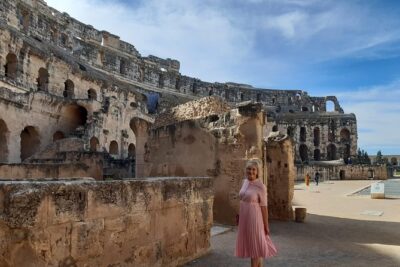
Private and Guided Tour to Kairouan and El Jem and Monastir
Read our review →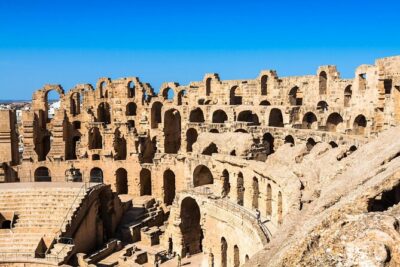
Kairouan & El Djem Guided Day Trip with Lunch from Hammamet
Read our review →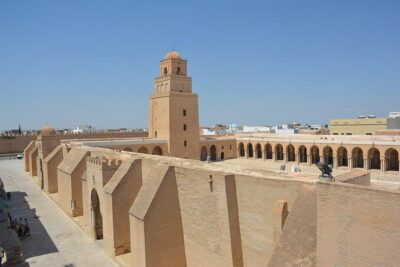
Kairouan Holy City and El Jem Colosseum Tour from Sousse
Read our review →Browse the lists this tour appears in