
Reviewed · DOUGGA & TESTOUR DAY TRIPS
Private Guided Tour of Dougga and Testour Mosque
Ancient Tunisia rewards the curious. This private day trip links Dougga’s remarkably complete Roman town with the lesser-known ruins of Ain Tounga and Testour’s unusual Andalusian mosque clock. I especially like the door-to-door pickup from Tunis or Hammamet, and the freedom of a private group that can explore Dougga without being tied to a large tour. The main drawback is the long six to seven-hour outing, with only about 30 minutes set aside for the Great Mosque of Testour.
The tour costs $127.81 per person, including admission tickets and vehicle transfers. That is a fair price if you value convenience and private guiding, especially with several people sharing the experience. Still, you should book this for archaeology first, not for a slow, in-depth visit to Testour.
In This Review
- Five reasons this Tunisia day trip deserves a closer look
- Dougga: Tunisia’s Roman town without the city around it
- Why Dougga feels different from Carthage
- Ain Tounga: an unfinished stop with real archaeological appeal
- Testour’s Great Mosque and its backward clock
- A private vehicle makes the route easier
- Is $127.81 a fair price?
- The guide can shape the whole day
- Who should book this experience?
- My call: book it for Dougga
- FAQ
- Where does the tour begin?
- How long does the tour last?
- Is this a private tour?
- Is transportation included?
- Are admission tickets included?
- How long is the Dougga visit?
- How long is the Great Mosque of Testour visit?
- What is unusual about the Testour mosque clock?
- Can I bring a service animal?
- Can I cancel for a full refund?
Five reasons this Tunisia day trip deserves a closer look
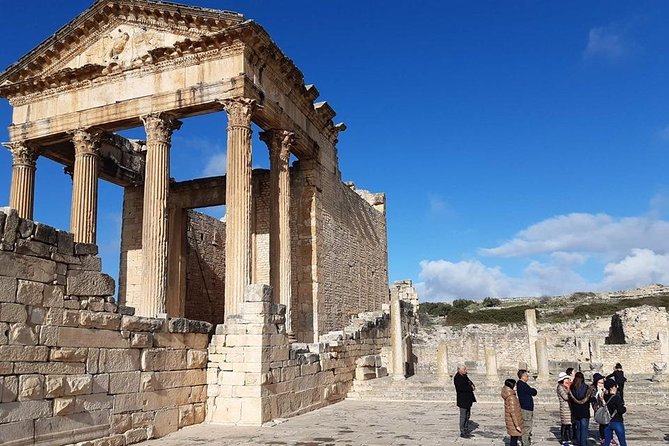
- Dougga preserves a whole Roman town: You see streets, houses, temples, tunnels, and a theater rather than one isolated monument.
- Ain Tounga adds a quieter archaeological stop: Its ruins sit along a hillside near fields and olive groves, with less development for tourism.
- The Testour mosque clock runs backward: Its hands turn counterclockwise, and its numbers are placed upside down.
- Private pickup keeps the day simple: Transfers are provided from your front door in Tunis or Hammamet.
- Guide Ghassen earns special praise: One five-star comment singles out his friendly manner and useful advice.
- The outing suits small private groups: Only your party participates, and group discounts may be available.
Dougga: Tunisia’s Roman town without the city around it
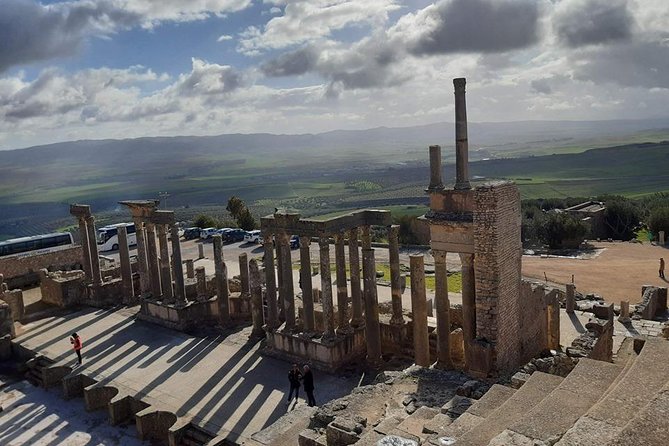
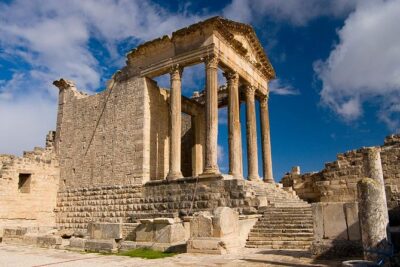
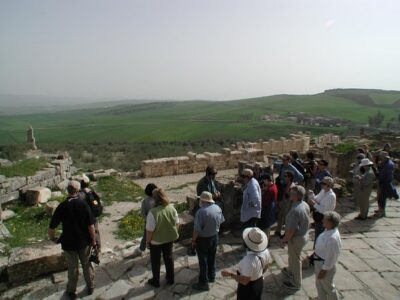
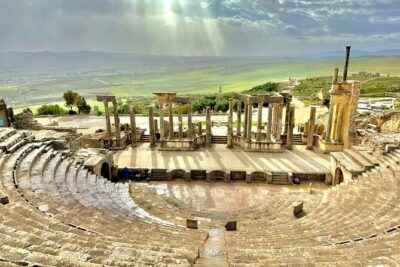
Dougga is the main reason to choose this excursion. The ruins sit on a hill above valleys planted with olive trees, and the approach by road brings you through open rural scenery. That setting matters. You are not looking at a single triumphal arch surrounded by modern traffic. You are walking through the remains of an entire ancient town.
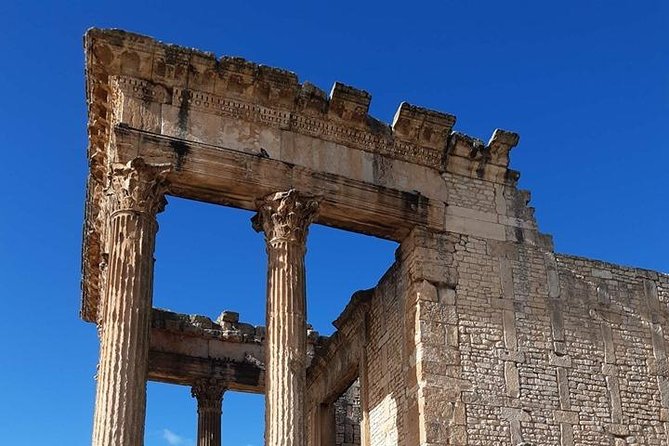
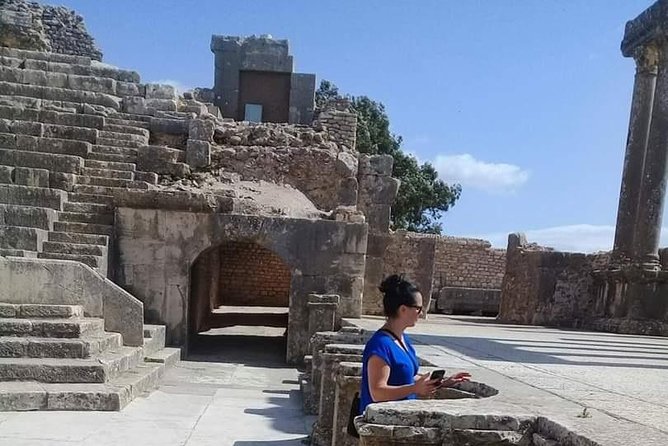
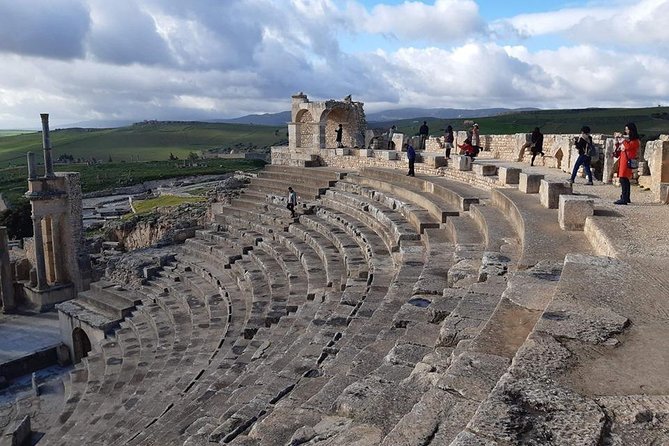
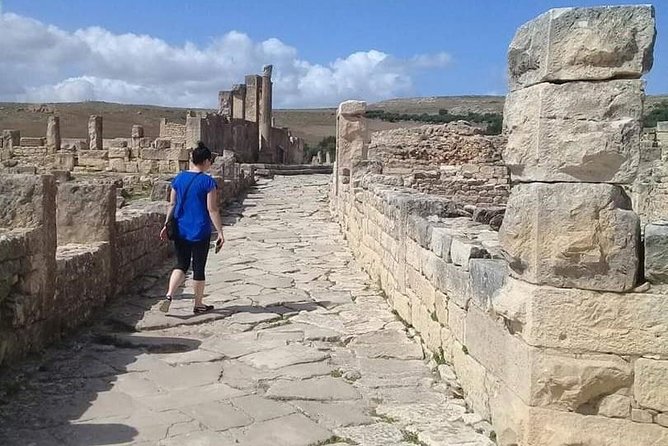
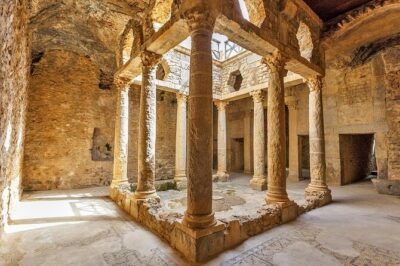
I like the sense of scale here. Roman streets still run between the ruins, and the site includes houses, temples, tunnels, and a theater. You can climb in and out of parts of the old settlement and take your time looking at how the pieces fit together. The experience feels less like checking off one famous monument and more like reading a town plan in stone.
The scheduled visit lasts about two hours, which gives you a useful first look at Dougga. It is long enough to see the principal remains, but you will still need to manage your pace. Dougga is extensive, and the uneven terrain means you may spend more energy moving between structures than you expect.
Your guide can help turn scattered walls into a readable story. Dougga was not only Roman. The site also contains evidence of earlier Phoenician and Punic settlement, including an old Punic temple with a cleansing bath. That earlier layer gives the visit more depth than a simple tour of Roman engineering.
Wear practical shoes and expect some climbing in and out of ruins. The information supplied for this experience does not promise a completely level route, and the description specifically emphasizes entering houses and tunnels, temples and the theater. You should be ready for an active archaeological visit rather than a viewpoint stop beside the bus.
More Dougga day trips:
- Private Excursion to Testour, Dougga and Bulla Regia from Tunis.
★ 5.0 · 100 reviews - Full Day Dougga & Bulla Regia Via Testour Private tour with Lunch
★ 5.0 · 29 reviews - Dougga and Bulla Regia Guided Tour From Tunis
★ 4.5 · 11 reviews
Why Dougga feels different from Carthage
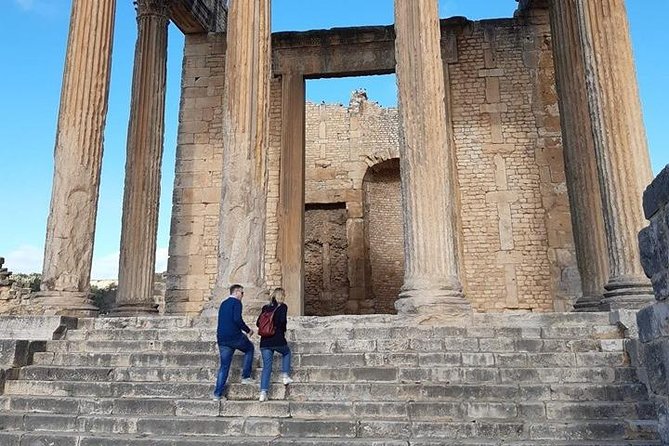
Carthage is easier to reach from Tunis, but its remains are spread across a modern urban area. At Dougga, the ancient streets and buildings are gathered into a broad site on the hill. That contrast is one of the strongest reasons to make the longer journey.
I find the rural setting particularly useful for understanding the town. The valleys and olive plantations help explain why this high point mattered. You can see the old settlement as a place connected to farmland and regional routes, not as an isolated monument placed for modern visitors.
The private format also works well here. A large group can make narrow passages and irregular ruins feel crowded. With only your own party, you can ask questions as they arise and give more attention to the places that interest you. The available information does not promise unlimited time at every feature, but private travel normally gives you more control than a fixed group departure.
The trade-off is travel time. Dougga is not a quick side trip from Tunis, and pairing it with Ain Tounga and Testour makes this a full day. If you prefer museums, cafés, and short walks, the schedule may feel demanding. If ancient sites are your priority, the time in the vehicle is the price of reaching one of Tunisia’s most complete archaeological settings.
Ain Tounga: an unfinished stop with real archaeological appeal
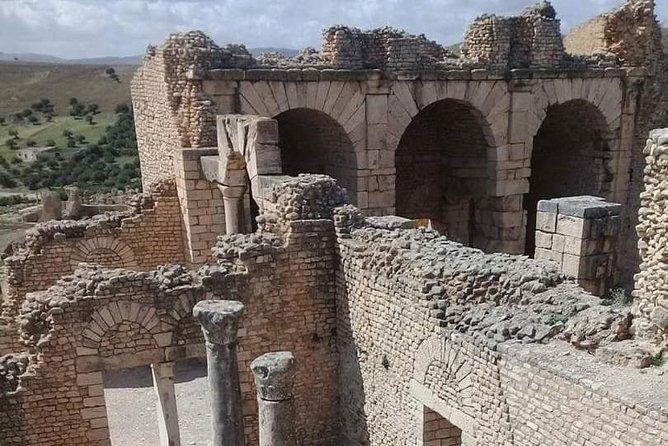
Ain Tounga is the more unusual part of the route. It lies between Testour and Dougga, close to the road, where a large square tower in ruins hints at the site’s entrance. From the roadside, you would not necessarily guess that a substantial archaeological area spreads along the hillside.
This is not presented as a fully developed visitor complex. The site includes fields and olive groves, and the available description stresses that it has not yet been fully highlighted or developed for visits. That can be a plus if you want a quieter, less polished place. It can also mean that the stop feels less structured than Dougga.
I would treat Ain Tounga as a bonus for people who enjoy archaeology in its less tidy form. You may see remains in a setting where the surrounding countryside is still part of the experience. The absence of extensive visitor development can make the place feel direct and unfiltered, but it may also mean fewer clear paths or explanatory features. The supplied details do not give a fixed visit length, so ask your guide how much time is planned on the day.
The site helps connect the major stops. Rather than driving straight from Dougga to Testour, you get another look at Tunisia’s scattered ancient settlements. That makes the route more rewarding for anyone who wants more than the standard Carthage circuit.
Testour’s Great Mosque and its backward clock
The Great Mosque of Testour is a very different stop. Instead of Roman columns and hilltop ruins, you get a landmark shaped by Andalusian influence. The minaret contains a clock unlike an ordinary modern timepiece: its hands move in the opposite direction, and the numbers are placed upside down.
The clock had been out of service for a long period, then began working again in December 2014. That small mechanical detail gives the mosque a memorable hook. You do not need a full day here to understand why the building is included in the route.
The scheduled visit is about 30 minutes, and admission is free. I see that as enough time for a focused look, especially after the much larger Dougga site. It is not enough for an extended architectural study, a long town walk, or a leisurely visit around Testour. The tour clearly treats the mosque as a short cultural stop rather than the main event.
The backward clock also points to Testour’s Andalusian past. The supplied details do not provide a full guided history of the town, so you should ask questions if this part interests you. A good guide can help explain the connection between the mosque’s design and the Andalusian communities associated with the town.
A few more excursions of this kind worth a look:
- Private Tour to Kairouan, El Jem & Monastir from Tunis_hammamet
★ 5.0 · 301 reviews - Private tour: Medina,Carthage ,Sidi Bou Said, Bardo Museum+lunch
★ 5.0 · 230 reviews - Carthage, Bardo Museum, Sidi Bou Said and Medina Private Day Tour
★ 4.5 · 153 reviews - Guided Bike Tour of Carthage Archeological Site in Tunisia
★ 5.0 · 88 reviews
A private vehicle makes the route easier
Pickup and drop-off are offered from Tunis or Hammamet, and the vehicle transfer is included. That is a major part of the tour’s value. Dougga and Ain Tounga are not the kind of sights you choose for easy, independent hopping between train stations and city streets.
The experience lasts approximately six to seven hours. Because the route includes several distant stops, front-door transportation saves you the work of arranging separate taxis, finding the archaeological entrances, and coordinating the return trip. You can focus on the sites instead of the route.
The private setup is important. Your party is the only group participating, so the outing does not require you to follow the pace of strangers. That can be especially helpful at Dougga, where you may want to pause at a temple, examine a street, or ask about the Punic remains.
There is one practical limit: private does not mean the day is completely open-ended. The tour still has a planned route and a stated duration. With Dougga receiving roughly two hours and Testour 30 minutes, the day is designed to cover several places efficiently. If you want an exhaustive visit at one site, ask about timing before you book.
Is $127.81 a fair price?
At $127.81 per person, this is not the cheapest way to see ancient Tunisia. The price includes admission tickets and private vehicle transfers, though, which changes the calculation. You are paying for transport, a guide, door-to-door service, and a route that would be awkward to arrange on your own.
The value improves when several people share the vehicle. Group discounts are offered, although the available information does not state the exact discount. A couple or family should compare the total cost with hiring separate transport and arranging site visits independently.
I would consider the price worthwhile if you are staying in Tunis or Hammamet and want Dougga without handling the logistics yourself. It is less compelling if you already have reliable private transport, prefer to travel independently, or plan to spend only a short time at the ruins.
Admission is included for Dougga and Ain Tounga, while the Great Mosque of Testour has free entry. That means you are not being asked to pay extra at the main stops. Still, confirm exactly what is included when booking, especially if your pickup point or group size needs special arrangements.
The guide can shape the whole day
The only named guide in the supplied feedback is Ghassen, who is praised for being friendly and offering good advice. That is useful information because Dougga benefits from interpretation. Without context, the site can become a long series of stones, arches, and partial walls. With a guide, you have a better chance of understanding how the streets, homes, temples, and theater formed one town.
I would ask your guide early about the Punic remains and the cleansing bath. Those details help you see Dougga as a place with several historical periods, not simply a Roman ruin. At Ain Tounga, ask how the visible tower relates to the wider site and what is known about the remains along the hillside.
At Testour, ask about the unusual clock and the Andalusian influence on the Great Mosque. The 30-minute stop goes quickly, so a few focused questions will make it more useful.
The overall rating is 4.3 out of 5 from 15 ratings. That is a solid result, though not a reason to expect a perfect experience for every group. The strongest praise centers on Dougga and the guide, which matches my own reading of the tour’s design: this is primarily an archaeological outing with two contrasting additions.
Who should book this experience?
I would recommend it most strongly to:
- First-time visitors who want to see Dougga without arranging transport
- Couples, families, and small groups who prefer a private vehicle
- People who enjoy Roman, Punic, and other ancient sites
- Visitors based in Tunis or Hammamet
- Anyone interested in unusual local details, such as Testour’s counterclockwise clock
You may want another plan if you dislike long road transfers, need a slow pace, or want a full town visit in Testour. You should also think carefully about the physical demands of Dougga. The route includes ruins, streets, tunnels, temples, and a theater, so it is not simply a drive-up photo stop.
Confirmation is provided when you book. Service animals are allowed, public transportation is nearby, and most people can participate. The tour requires good weather, and cancellation is free up to 24 hours before the start time. If poor weather forces cancellation, you can receive a different date or a full refund.
My call: book it for Dougga
I would book this tour if Dougga is high on your Tunisia list and you want a private, practical way to reach it. The complete Roman town, the hilltop views, and the earlier Punic remains give the day real substance. Ain Tounga adds a less developed archaeological stop, while Testour supplies a memorable cultural detail in the form of its backward clock.
I would not book it expecting a relaxed village tour or an extended mosque visit. The schedule is built around Dougga, and the other stops fill out the route. For archaeology-minded visitors, the combination is strong value. For everyone else, the six to seven-hour commitment may be more than the short Testour stop can justify.
FAQ
Where does the tour begin?
Pickup is offered from your front door in Tunis or Hammamet.
How long does the tour last?
The experience lasts approximately six to seven hours.
Is this a private tour?
Yes. Only your group participates in the activity.
Is transportation included?
Yes. Comfortable vehicle transfers from Tunis or Hammamet are included.
Are admission tickets included?
Admission tickets are included for the archaeological visits. Entry to the Great Mosque of Testour is free.
How long is the Dougga visit?
The planned visit to Dougga lasts about two hours.
How long is the Great Mosque of Testour visit?
The scheduled stop at the mosque lasts about 30 minutes.
What is unusual about the Testour mosque clock?
Its hands move counterclockwise, and its numbers are placed upside down.
Can I bring a service animal?
Yes. Service animals are allowed.
Can I cancel for a full refund?
Yes, if you cancel at least 24 hours before the experience starts. Poor-weather cancellations offer a different date or a full refund.
Just added around Tunis
- 3-Day South of Tunisia Guided Tour from Tunis★ 4.0 · 3 reviews
- Explore Tunisia in Depth:The Private Grand Tour in 8 Days★ 5.0 · 3 reviews
- Private Tour Bardo Museum, Carthage, Sidi Bou Said and Medina★ 4.5 · 3 reviews
- Private Group Day Tour Tunis Medina Carthage Sidi Bou Said★ 4.5 · 3 reviews
- 5 Days Tunisia Discovery Private Tour★ 5.0 · 4 reviews
- Bardo Museum- The ruins of Carthage- Village of Sidi Bou Said★ 5.0 · 4 reviews
- Tunis Carthage Private Arrival Airport Transfer to Tunis★ 5.0 · 4 reviews
- 4-Day Private Tour: Sahara and Djerba Island from Tunis and Hammamet★ 5.0 · 4 reviews
Dougga & Testour Day Trips, compared.
Private Excursion to Testour, Dougga and Bulla Regia from Tunis.
Read our review →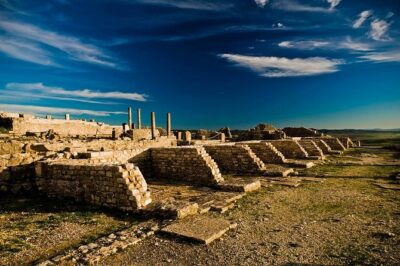
Full Day Dougga & Bulla Regia Via Testour Private tour with Lunch
Read our review →
Private Day Trip to Testour, Dougga and Bulla Regia from Hammamet
Read our review →
DAY TRIP TO Dougga & Bulla Regia , DEPARTURE FROM Tunis
Read our review →Browse the lists this tour appears in